1Before you start
This guide takes you from an unopened box to your first finished hand. Read it once, in order. Then keep it nearby for the questions that come up mid-game.
In the box
- 160 tiles: 36 Dots, 36 Bams, 36 Craks, 16 Winds, 12 Dragons, 8 Flowers, 10 Jokers and 6 Blanks
- Two dice in a pouch
- A tile bag that holds the whole set
- Four tile guide cards, one for each player
- A magnetic gift box to keep it all in
You will also need
- This year’s card from the National Mah Jongg League, one per player. It is sold separately (see How to win).
- Four racks with pushers. These tiles are larger than most, so use 20-inch racks.
- Chips or coins, if your table plays for points.
Before your first game
Sort the tiles and count them against the list above. Then put two Jokers and all six Blanks back in the bag. You play with 152 tiles. The rest are spares.
2The tiles
Three suits run from 1 to 9, with four of every tile. Read the small number in the top corner first, then the suit.
On most sets the 1 Bam is a bird, not a single stick. Read the corner number first.
There are four of each Wind: East, South, West and North. There are four of each Dragon: Red, Green and White. The White Dragon is called the Soap.
3Dragons, Flowers and Jokers
Each Dragon belongs with a suit: Red with Craks, Green with Bams, and the Soap with Dots. On the card, a Dragon printed in the same color as a group of numbers is the Dragon of that suit. The Soap can also stand for a zero.
There are eight Flowers. In American play they all count as the same tile. Their drawings differ only for pleasure.
Play with eight Jokers. A Joker stands in for any tile in a group of three or more identical tiles (see Jokers).
The Blanks and two extra Jokers are spares. Keep them in the bag. If a tile is ever lost, mark a Blank to replace it. Some tables also play with the Blanks (see Paying).
Your four tile guide cards show every face. Keep one by each rack until the tiles feel familiar.
4How to win
Everyone plays to the same list of winning hands, printed on a card by the National Mah Jongg League. The first player whose 14 tiles match one hand on the card exactly says “Mahjong” and wins.
Hands are built from groups of identical tiles: a pair is two, a pung three, a kong four, a quint five and a sextet six. A lone tile is a single. There are only four of most tiles, so a quint or sextet usually needs Jokers.
Reading the card
- Colors stand for suits, but not for any particular suit. Numbers in one color are one suit; a second color means a second, different suit. You choose which suits.
- D is a Dragon (each goes with a suit, see Dragons, Flowers and Jokers), F a Flower, and N, E, W, S are the Winds. A 0 is the Soap.
- X means the hand may be exposed; C means concealed (see Jokers). The number at the end is what the hand is worth.
Getting the card
The League sells it, in standard and large print, at nationalmahjonggleague.org. A new card comes out every spring and the hands change, so buy this year’s. Because it changes every year, it does not come with this set.
If your table disagrees on a rule, the League’s own rulebook, Mah Jongg Made Easy, has the final word.
5Setting up
Four players sit around a square table, each behind a rack.
- Choose East. Each player rolls the dice. The highest roll is East, the dealer.
- Mix. Turn all 152 tiles face down in the middle and mix them well.
- Build the walls. Each player builds a wall in front of their rack, 19 tiles long and two high. Push the four walls together into a square.
- Break the wall. East rolls the dice, counts that many stacks from the right-hand end of East’s own wall, and separates the wall there.
- Deal. East takes the two stacks to the left of the break: four tiles. Each player to the right then takes the next four. Go around three times, so everyone has 12.
- Finish the deal. East takes the top tile of each of the next two stacks. The others then take one tile each, in turn.
East now has 14 tiles and everyone else has 13. Stand your tiles on your rack, facing you. Later draws come from where the deal stopped.
Nobody plays yet. The Charleston comes first.
6The Charleston
Before play, everyone trades away tiles they do not want. Each pass is three tiles, face down. Jokers are never passed.
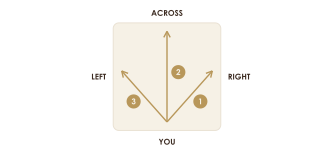
The first Charleston (always played)
- Pass three tiles to the player on your right.
- Pass three tiles across the table.
- Pass three tiles to your left.
On that last pass you may pass blind: if you cannot spare three tiles, pass on one, two or all three of the tiles being passed to you, without looking at them.
7After the first Charleston
The second Charleston (optional)
If all four players agree, trade again in reverse order: left, across, right. Any player may stop it before it starts, no reason needed. You may pass blind on the last pass.
The courtesy pass
Last, you may trade up to three tiles with the player across from you. The one who wants fewer sets the number, and none is fine.
What to pass
- Sort your tiles first, suit by suit, with Winds, Dragons and Flowers at one end.
- Look at the card before your first pass. Choose two or three hands your tiles could make, and keep what they need.
- Pass tiles that fit none of them: odd Winds, a lone Flower, a suit you are not using.
- Hold on to pairs. You can change your mind after any pass; most players do.
Then East discards, and play begins.
8Playing a hand
East starts by discarding one tile face up in the middle and naming it aloud: “Six Bam.” Play then moves to the right, around the table.
On your turn
Draw the next tile from the wall. Keep it or not, then discard one tile face up and name it. You always end your turn with 13 tiles.
Calling a discard
Instead of drawing, you may take the tile just discarded, but only if it completes a pung, kong, quint or sextet for a hand on the card, or if it gives you Mahjong.
- Say “Call” at once. Take the tile, set the whole group face up on top of your rack, then discard as usual. Once you have discarded, you cannot add to the group or change it.
- You cannot call for a single or a pair, except the last tile you need for Mahjong.
How long a discard stays live
Until the next player, having drawn from the wall, puts that tile on their rack, discards, swaps for a Joker or declares Mahjong. After that it is dead and stays in the middle. If someone calls in time, the drawn tile goes back on the wall.
Two players call the same tile
A call for Mahjong beats a call for a group, even one already being laid out. Between two calls of the same kind, the player next in turn after the discarder gets the tile, unless the other player has already started laying out tiles.
9Jokers
- A Joker stands in for any tile in a pung, kong, quint or sextet.
- Never use a Joker as a single tile or in a pair.
- Jokers may go in exposed groups. You may call a tile and expose it with Jokers from your rack.
- A discarded Joker is dead. Nobody may call it.
- Jokers are never passed in the Charleston.
The Joker exchange
If a Joker sits in an exposed group on anyone’s rack, and you hold the real tile it stands for, you may swap them. Do it on your turn, after you draw or call a discard and before you discard. You may make as many swaps as you can.
Hold a real 5 Bam? On your turn, put it in place of the Joker and take the Joker.
Concealed and exposed hands
A hand marked X on the card may be built with called groups showing on your rack.
A hand marked C is concealed. You may not call any discard for it, except the last tile you need for Mahjong.
10Ending a hand
Mahjong
When your 14 tiles match one hand on the card exactly, say “Mahjong” and lay your tiles face up for everyone to check. You may win on a tile you draw or on one somebody discards, even if it completes a pair or a single. The others keep their tiles standing until the hand is checked.
Check your tiles against the card before you say it; a wrong call can kill your hand. Lay the tiles out in the same order as the hand on the card, so the others can check it quickly.
Dead hands
A hand is dead if, for example, it has the wrong number of tiles, if an exposed group fits no hand on the card, or if its owner calls Mahjong by mistake and has already laid the tiles out. A wrong call caught before any tiles are shown, and before anyone else disturbs their hand, costs nothing: play goes on.
Any player may point it out. The dead hand stops drawing and discarding but still pays the winner. The others play on.
Wall game
If the wall runs out before anyone wins, the hand is a draw. Nobody pays.
The next hand
Mix the tiles and build the walls again. The deal passes to the right after every hand, whoever won.
11Paying
Many tables play for small stakes; many play for nothing and just keep score. The sums are the same either way.
- Each losing player pays the winner the value printed beside the hand on the card.
- The player who discarded the winning tile pays double.
- If the winner drew the winning tile from the wall, everyone pays double.
- A hand with no Jokers doubles again, except hands in the card’s Singles and Pairs section, which never use Jokers.
- A wall game pays nothing.
| Example: a hand worth 25 | Who pays what |
|---|---|
| Won on a discard | Discarder 50, others 25 |
| Won on a discard, no Jokers | Discarder 100, others 50 |
| Drawn from the wall | Everyone 50 |
| Drawn from the wall, no Jokers | Everyone 100 |
House rules
Tables differ on small points: whether to play the second Charleston, what a point is worth, how many hands make an evening. Agree before you start, and tell your guests.
Playing with Blanks. Some tables put Blanks into play: a player may trade a Blank for any tile already discarded, even a dead one. This is not a League rule and tables play it differently, so agree first how many Blanks go in and when they may be used.
12Your first games
- Pick two or three hands on the card and aim for those. Nobody reads the whole card mid-game.
- Play your first hand with everyone’s tiles showing, and talk it through.
- Skip the second Charleston until everyone is comfortable.
- Expect the first game to be slow. By the third it flows.
- Keep a tile guide card by your rack. Its back has the Joker rules, the Charleston, paying and a key to the card.
Mistakes that cost a hand
- Calling a discard for a pair. Only the Mahjong tile may finish a pair.
- Using a Joker as a single tile or in a pair.
- Calling after the next player has drawn and racked.
- Exposing a group that fits no hand on the card.
- Calling on a concealed hand. Check for the C first.
- Ending a turn with 12 or 14 tiles. Count when something feels off.
Good table habits
- Name every discard clearly and put it where all four players can see it.
- Keep the game moving: draw, decide, discard.
- Pass Charleston tiles face down, all three at once.
13Words you will hear
- Blind pass
- Passing on tiles passed to you, without looking.
- Call
- Taking a discard to complete a group or to win.
- Charleston
- The rounds of three-tile passes before play.
- Concealed (C)
- A hand that may call only its winning tile.
- Courtesy pass
- The last trade, up to three tiles, across.
- Dead hand
- A hand ruled out for an error. It still pays.
- East
- The dealer. The seat moves right each hand.
- Exposure
- A called group shown face up on a rack.
- Joker exchange
- Swapping a real tile for an exposed Joker.
- Pung, kong
- Three or four identical tiles.
- Quint, sextet
- Five or six identical tiles, usually with Jokers.
- Soap
- The White Dragon. On the card, also a zero.
- Wall game
- A hand nobody wins. Nobody pays.
Learn more
Clubs, libraries and community centers often run games for beginners. Sitting in on one is the fastest way to learn.
Tables differ on small points; when they disagree, the National Mah Jongg League's own rulebook, Mah Jongg Made Easy, has the final word.